

 Photo: Viktar Palstsiuk · CC BY-SA 4.0 · edited
Amphitheatre de Pula
Open today 09:00–17:00Adults EUR 10 · Children, pupils, students EUR 5
Tickets from EUR 10Sign up free — See who's going and message them.
Is this your place? Get the badge for your websiteAbout
More photos 11
1 / 11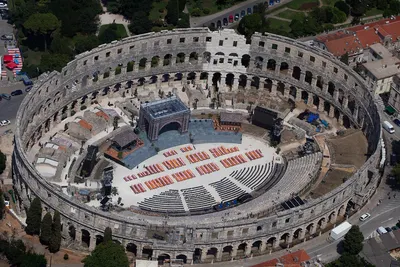


Why go
- Opera and concerts on the 67.90 by 41.60 metre arena floor, prized for their acoustics; Sting and Luciano Pavarotti have performed here.
- The restored east-side seating, about 5,000 places today; the full bowl once held about 23,000.
- The outer wall, with all three Roman architectural orders fully preserved, which no other amphitheatre in the world has.
- Preserved supports of the canvas awning, which devices in four towers once tightened against sun and rain.
Plan your visit
Opening times
Prices
From the venue's website · checked 27 Oct 2026
Don't miss
- Headstone of Gabriele EmoA headstone on the second tower honours the Venetian senator who opposed the 1583 plan to take the arena apart.On the second tower On the map
- The underground exhibitionA permanent display on the history of ancient oil and wine production, in the space beneath the arena floor.Underground, beneath the arena floorDaily, with the arena On the map
- The towers of the outer wallEach tower had a rainwater tank, possibly used to sprinkle the crowd on hot days.In the towers of the outer wall On the map
- The arched outer wallTwo tiers of arches, 72 in all, topped by 64 window niches; local limestone, up to 32 metres high on the sea side.The outer wall, around the whole arena On the map
Know before you go
- Open every day: 08:00–20:00 in April, 08:00–21:00 in May and September, and 08:00–22:00 from June to August.
- In October the arena opens 08:00–19:00; from November to March it opens 09:00–17:27.
- Tickets are sold on the arena's own website, and buying online is recommended to avoid entrance queues.
- Visitors may take photographs in all areas.
- Visitors are asked not to climb on the raised structures, for their safety and to protect them.
- The arena may be closed to visitors on days when events are held.
- Concert sound checks, stage assembly and equipment set-up can take place during opening hours.
- The Archaeological Museum of Istria may report visitor behaviour that breaks the rules or the law.
Tips for your visit
- Scan the QR codes at the entrance and at set points for free audio guides in several languages.
- The arena is at Flavijevska ul. in Pula; the phone number is 052351300.
Best time to visit
- The arena is open in every month of the year, so the season changes the hours, not whether you can visit.
- June to August is the longest stretch of opening hours, so it leaves the most time in the evening.
- Check the event schedule before you go; event days can affect the visit (see Know before you go).
With kids
- Children, pupils and students pay 5 EUR, against 10 EUR for adults.
- Local legend says fairies raised it in one night and left the work unfinished.
- Rainwater tanks in the towers may have sprinkled the crowd when the days were hot.
- The folk name Divić-grad is built from an old word meaning wonder.
Interesting facts8
-

It is the largest and best-preserved ancient building monument in Croatia.
Amfiteatar u Puli - Wikipedia -

The name arena comes from harena, the Latin word for sand.
Amfiteatar u Puli - Wikipedia -

Its interior was lost over the centuries, but the white limestone facade is largely original.
Amphitheater Pula - Wikipedia -

Its eastern side rests on a hill, so it looks much lower from outside.
Amphitheater Pula - Wikipedia -

Its stones were partly reused in other Pula buildings, including the castle.
Amphithéâtre de Pula - Wikipedia -

Sebastiano Serlio and Andrea Palladio drew its construction and decoration details.
Amfiteatar u Puli - Wikipedia -
 200 metres
It lies about 200 metres northeast of the city walls, laid out on the Roman land grid.
Pula Arena - Wikipedia -
 1999
Julie Taymor's 1999 film Titus was shot here.
Pula Arena - Wikipedia
Shorts


History
The arena was built on the western slope of a hill above the bay. A few decades after its first, probably wooden version, it was constructed in stone, probably under Claudius. Fights with condemned prisoners and wild animals continued until they were banned in 681. In the Middle Ages the interior hosted fairs and chivalric tournaments. Restoration began under General Auguste de Marmont while he governed the Illyrian Provinces. Architect Pietro Nobile continued it. The last reconstruction ran from 1984 to 1986.
- 1st centuryUnder Augustus, a first, probably wooden version is built.
- 79 ADVespasian enlarges it for gladiator fights, beside the Via Flavia.
- 81 ADTitus completes it.
- 5th centuryEmperor Honorius bans gladiator fights here, ending the arena's original use.
- 1583The Venetian Senate proposes taking it apart and rebuilding it in Venice; a senator opposes the plan.
Show all
- 1709The last stone is quarried, for the foundations of a cathedral bell tower.
- 1816Architect Pietro Nobile continues the restoration for Emperor Francis I of Austria.
- 1932Part of the seating, about 5,000 places on the east side, is restored; the arena is adapted for theatre, military ceremonies and public meetings.
Sources: Pula Arena - Wikipedia · Home · Visitor info · About amphitheater · Amphithéâtre de Pula - Wikipedia · Amphitheater Pula - Wikipedia · Amfiteatar u Puli - Wikipedia · Amphitheatre de Pula: tickets (its own site) · checked 19 Oct 2026
- Website
- arenapula.hr/en/
- Phone
- 052351300
Questions and answers
How much does a ticket for the Amphitheatre de Pula cost?
Adults pay 10 EUR. Children, pupils and students pay 5 EUR.
What are the opening hours of the Amphitheatre de Pula?
It is open every day: 08:00–20:00 in April, 08:00–21:00 in May, 08:00–22:00 from June to August, 08:00–21:00 in September, 08:00–19:00 in October and 09:00–17:27 from November to March.
Should I book tickets in advance for the Amphitheatre de Pula?
Buying online is advised, because it helps you skip the queue at the entrance.
Where is the Amphitheatre de Pula?
It is on Flavijevska ul. in Pula, Istria, inside the city area, about 200 metres northeast of the old city walls.
Does the Amphitheatre de Pula host concerts?
Yes. It is often used for opera, concerts and theatre, and Sting, Luciano Pavarotti and Elton John have performed there.
- See who's going — faces, not ticket counts.
- Write to someone who shares your interests — no swipes, no matches, no paywall.
- Pick the event or the place to meet at — and go together.