
 Photo: Barbara y Eugenio - https://www.flickr.com/photos/12482011@N00 · CC BY 2.0 · edited
Bru na Boinne
Open today 09:00–16:15Adult EUR 40 · Senior (aged 60 years or over) EUR 30 · Student (with Valid Student ID) EUR 10
Sign up free — See who's going and message them.
Is this your place? Get the badge for your websiteMore photos 11
1 / 11
 Dieglop · CC BY-SA 4.0 · edited


Why go
- The ceremonial monuments are among the world’s most important Neolithic sites.
- Newgrange, Knowth and Dowth are known for their collections of megalithic art.
- Newgrange and Dowth align with the winter solstice; Knowth aligns with both equinoxes.
- At least 90 monuments include tombs, burial mounds, standing stones and enclosures.
Plan your visit
Opening times
Prices
From the venue's website · checked 27 Oct 2026
Don't miss
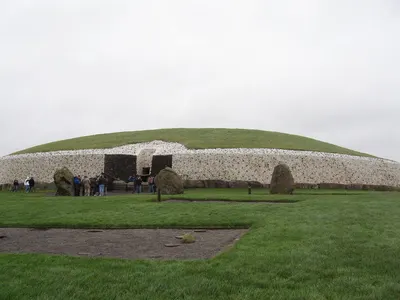
- Newgrange’s passage and burial chamberBeneath a circular cairn over 100 metres across, a 19-metre passage lined with 43 side pillars leads to a chamber about six metres high. Three side niches form a cross, with large stone basins intended for human bones and offerings.Inside Newgrange, on a guided tour
- Knowth’s moundThe mound measures 67 metres across and 12 metres high and contains two tombs; its chambers are closed to visitors.Knowth, on a guided tour
- Visitor Centre exhibitionInteractive displays explore Neolithic culture, the landscape and the monuments.Visitor Centre
Know before you go
- Book tickets in advance for Newgrange and Knowth; entry is by guided tour through the Visitor Centre.
- Travel from the Visitor Centre to Newgrange and Knowth by shuttle bus with a guide.
- Photography is prohibited inside Newgrange’s passage and chamber.
Tips for your visit
- The monuments are outdoors without shelter.
- An audio guide is available for the Visitor Centre exhibition.
- The Visitor Centre has a café, bookshop and gift shop.
Interesting facts6
-

The Boyne borders the site to the south, west and east; the Mattock runs along its northern edge.
Brú na Bóinne - Wikipedia -
 780 hectares
The landscape covers 780 hectares and contains around forty passage graves, alongside other prehistoric and later remains.
Brú na Bóinne - Wikipedia -

Knowth and Newgrange appear to contain stones reused from an earlier monument at the site.
Brú na Bóinne - Wikipedia -
 15 metres
Dowth is a mound 15 metres high and 85 metres wide containing two tombs.
Brú na Bóinne - Wikipedia -

Newgrange is the cemetery’s central mound.
Brú na Bóinne - Wikipedia -

In Irish mythology, the tombs are portals to the Otherworld and homes of deities including The Dagda and Aengus.
Brú na Bóinne - Wikipedia
History
The three best-known passage tombs stand on a hill in a bend of the Boyne, between Slane and Donore.
- At least 6,000 years agoThe area has evidence of human settlement reaching back at least 6,000 years.
- 3300–2900 BCConstruction of the passage tombs took place between about 3300 and 2900 BC. Newgrange, Knowth and Dowth date to around 3200 BC.
- Early Bronze AgeSettlement and ritual use continued into the early Bronze Age, when enclosures, including henges and other circles, were built.
- Later Bronze Age and Iron AgePeople used the area for ritual and ceremonial activity.
- 18th centuryAntiquarians began studying the tombs.
Show all
- 20th centuryExcavations began at the tombs.
- 1993Brú na Bóinne became a UNESCO World Heritage Site.
- 1997The Visitor Centre opened.
How to get there
- BusBus Éireann route 163 connects Drogheda with the Visitor Centre via Donore.
- BusThe Visitor Centre is in Donore, south of the Boyne; the monuments lie across the river to the north.
- ParkingThe Visitor Centre has a car park and bicycle parking.
Sources: Brú na Bóinne - Wikipedia · Brú na Bóinne Visitor Centre: Newgrange, Knowth… · Brú na Bóinne Visitor Centre: Newgrange, Knowth… · Brú na Bóinne - Wikipedia · Brú na Bóinne - Wikipedia · checked 24 Sep 2026
- Phone
- +353 41 988 0300
Questions and answers
What Roman objects were found near Newgrange?
Roman coins and jewellery were found near Newgrange as votive offerings.
How do you reach Newgrange and Knowth from the Visitor Centre?
A shuttle bus takes visitors from the centre to the monuments, where entry is by guided tour.
- See who's going — faces, not ticket counts.
- Write to someone who shares your interests — no swipes, no matches, no paywall.
- Pick the event or the place to meet at — and go together.