


Eiffel Tower
- Visit: 1–2 hours
Sign up free — See who's going and message them.
Is this your place? Get the badge for your websiteAbout
More photos 11
1 / 11


What's on here

Why go
- Reach the upper observation platform, 276 metres above ground and the European Union’s highest public deck.
- Dine at Le Jules Verne, the tower’s two-Michelin-starred restaurant on the second level.
- See the private summit apartment built for Gustave Eiffel, where he hosted guests including Thomas Edison.
Opening hours
Today09:30 – 23:00Show all
Don't miss
- Millennium exhibitionAn exhibition recalls the 1999 celebration, which featured flashing lights and fireworks.Above a first-level cafeteria
- Champagne barA champagne bar occupies the third level.Third level
- Original hydraulic lift mechanismSee the original hydraulic lift mechanism on display.Small museum at the east and west leg bases
- North tower rope mechanismLook for the rope mechanism as you leave the lift.North tower
- Gustave Eiffel bustAntoine Bourdelle’s bust of Gustave Eiffel was unveiled in 1929.Base of the north leg
Interesting facts7
-
 1930
At completion, the tower measured 312 metres; the Chrysler Building ended its height record in 1930.
Eiffelturm - Wikipedia -

Gustave Eiffel used his summit apartment for meteorological observations and air-resistance experiments.
Eiffel Tower - Wikipedia (part 2) -
 7,300 tonnes
The wrought-iron structure weighs 7,300 tonnes; lifts, shops and antennae bring the total to about 10,100 tonnes.
Eiffel Tower - Wikipedia (part 3) -

The tower’s top can shift up to 18 cm as its metal expands in sunlight.
Eiffel Tower - Wikipedia (part 3) -
 18,038 pieces
Its ironwork consists of 18,038 pieces joined with about 2.5 million rivets.
Eiffel Tower - Wikipedia (part 2) -
 125 metres
Its square base measures 125 metres on each side.
Eiffel Tower - Wikipedia -
 200 and
It was the first structure to exceed both 200 and 300 metres.
Eiffel Tower - Wikipedia
Shorts
-
 4K Paris City | Eiffel Tower | Drone FootageMinute By Minute
-
 Tour Eiffel | Eiffel Tower - Paris, France.Jean-Luc Ichard
-
 Eiffel Tower - Paris, France | KeeKee's Fun Facts Educational Videos …KeeKee's Big Adventures- Kids Educational Cartoons
-
 Eiffel Tower Construction Through the YearsBlackHeartData
-
 Eiffel Tower disasterJason Whittaker
-
 Eiffel Tower vs Tokyo Tower | Construction ComparisonBlackHeartData
-
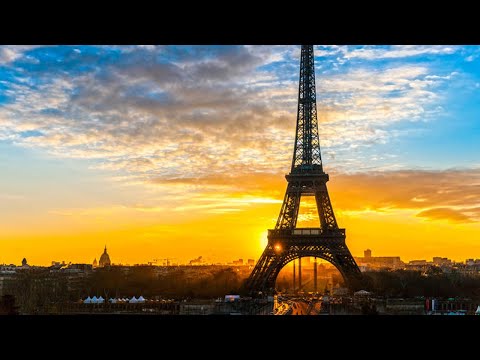 Visit the Eiffel Tower in Paris, FranceViator
-
 The Eiffel Tower marks its 130th birthday with a light showAFP News Agency
History
Maurice Koechlin and Émile Nouguier conceived the tower while working for Gustave Eiffel’s company. His monumental arch at the first level was decorative rather than structural. Its scientific and technological uses helped it survive, and it joined the International Time Service in 1910. It later became a symbol of Paris and France, a protected monument, and part of a UNESCO World Heritage Site.
- 1876Thomas Curtis Clarke and David Reeves proposed a tower for Philadelphia’s 1876 exhibition, but it was never built.
- 1881Amédée Sébillot proposed lighting Paris with a beacon on a sun tower.
- 1884Gustave Eiffel patented the tower design on 18 September.
- 1885Eiffel presented the plans to the Société des Ingénieurs Civils on 30 March.
- 1886About 100 applicants entered the design competition; three designs remained after the first selection.
Show all
- Spring 1886Stephen Sauvestre revised the design, adding masonry bases, changing the floors and decorations, and reshaping the lantern. His monumental first-level arch was decorative, not structural.
- 1887Artists protested the proposed tower before construction began. A location contract was signed on 8 January, and foundation work began on 28 January.
- 1887–1889Built as an entrance and viewing tower for the 1889 Exposition Universelle, it was intended to be temporary and scheduled for dismantling in 1909. Iron parts made in Levallois-Perret were assembled in Paris.
- 1888The second level was erected on 14 August.
- 31 March 1889The main structure was complete. Gustave Eiffel led officials and reporters to the summit.
- 15 May 1889The tower opened to the public nine days after the exposition began on 6 May, while its lifts were still unfinished. Nearly 30,000 visitors climbed 1,710 steps to the summit before the lifts began operating.
- 1889During the exposition, Le Figaro ran an office and printing press on the second level, producing a souvenir edition. A summit post office let visitors send letters and postcards. Eiffel used his apartment for weather observations.
- 1901Alberto Santos-Dumont won a prize for flying an airship from St. Cloud to the tower and back in under half an hour.
- 1909The tower was nearly demolished, but its value for science and technology, including telegraphy, helped it survive.
- 1910It joined the International Time Service, sending daily time signals to ships.
- 1914Its radio transmitter jammed German communications and hindered their advance on Paris.
- 1918The tower had become a symbol of Paris and France. Guillaume Apollinaire wrote a tower-shaped nationalist calligram during the war against Germany.
- 1925Con artist Victor Lustig twice claimed to sell the tower for scrap.
- 1925–1934Citroën signs on three sides made it the world’s tallest advertising space at the time.
- 1926Pilot Leon Collet died while attempting to fly beneath the tower.
- 1930The Chrysler Building’s completion ended the tower’s title as the world’s tallest structure.
- 1935The tower was used for experimental low-resolution television transmissions.
- 1938The decorative arcade around the first level was removed.
- 1940–1946French forces cut the lift cables during the occupation. The lifts remained unrepaired until 1946.
- 1956–1957A fire damaged the top in 1956; repairs lasted a year. A broadcasting aerial was added in 1957.
- 1964The tower was declared a historic monument.
- 1965An additional lift system was installed in the north pillar.
- 1981A former restaurant near the top was removed after engineers found its weight was making the tower sag.
- 1982The lifts between the second and third levels were replaced, and emergency staircases took the place of the original spiral stairs.
- 1983A motorized Otis lift was installed in the south pillar to serve the Jules Verne restaurant.
- 1986The east and west leg lifts were refurbished and automated. The American Society of Civil Engineers named the tower an engineering landmark.
- 1991The tower became part of the UNESCO World Heritage Site “Paris, Banks of the Seine.”
- 2004A seasonal ice rink began operating on the first level.
Tips for your visit
- There are three visitor levels, with restaurants on the first and second levels.
- Stairs in the south pillar reach the second level, about 600 steps from the ground. Lifts in the north, west and east pillars serve the first two levels.
- Reaching the third level normally requires a further lift ride from the second level.
- Le Jules Verne has a dedicated lift from the south pillar.
How to get there
- TrainNearby stations include Bir-Hakeim, École Militaire and Champ de Mars–Tour Eiffel.
- On footFrom the École Militaire Métro, walk up the Champ de Mars to the tower.
- TrainExit the Métro at Trocadéro for a view of the tower from across the École Militaire.
Accessibility
- Access above the second level Visitors with disabilities cannot go above the second level for safety reasons.
Sources: Eiffel Tower - Wikipedia · Eiffel Tower - Wikipedia (part 2) · Eiffel Tower - Wikipedia (part 3) · Paris/7th arrondissement - Wikivoyage (see) · Eiffelturm - Wikipedia · Tour Eiffel - Wikipedia · checked 24 Sep 2026
- Website
- toureiffel.paris/fr
- Phone
- +33 892 70 12 39
Questions and answers
Why was the tower nearly demolished?
Built as a temporary entrance and viewing tower for the 1889 Exposition Universelle, it was scheduled for dismantling in 1909.
How many people worked on its construction?
There were 300 workers on site; one worker died during construction.
Does the tower move in the wind?
It can sway by up to 9 cm.
- See who's going — faces, not ticket counts.
- Write to someone who shares your interests — no swipes, no matches, no paywall.
- Pick the event or the place to meet at — and go together.