


Holstentor
Sign up free — See who's going and message them.
Is this your place? Get the badge for your websiteAbout
More photos 8
1 / 8


What's on here
 Das Holstentor, Lübeck und die Welt - Macht durch Handel
Sunday · All day
Das Holstentor, Lübeck und die Welt - Macht durch Handel
Sunday · All day
Das Holstentor, Lübeck und die Welt - Macht durch Handel
Sunday · All day
Das Holstentor, Lübeck und die Welt - Macht durch Handel
Sunday · All day
Das Holstentor, Lübeck und die Welt - Macht durch Handel
Sunday · All day
Why go
- One of Lübeck’s two surviving medieval city gates.
- Two round towers joined by a central building above the gateway.
- The world’s oldest clearly dated ship in a bottle, made by Georg Biondi in 1784.
- Models of Hanseatic ships, including the flagship Eagle of Lübeck.
Opening hours
Today10:00 – 18:00Show all
Don't miss
- Terracotta bandsLook for lilies, latticework and thistle leaves in the two terracotta bands.Around the gate
- Field-side inscriptionRead “Concordia domi foris pax,” meaning unity at home and peace outside.Field side of the gate
- Iron lionsFind the two reclining iron lions; one sleeps while the other watches.Western end of the green space opposite the gate
Know before you go
- Open Monday to Saturday, 10:00–18:00, and Sunday, 10:00–17:00.
- Buy tickets online through the museum’s own site.
What's inside
- Nine themed rooms on the first through third floors explore maritime trade, fortifications, shipping, Lübeck law, city development, punishment and torture.
- A model of Lübeck’s city centre and market accompanies exhibits about shipping routes.
- The second-floor chambers display cannons installed later, rather than original gate artillery.
- Top-floor displays explain Lübeck law and its legal community of 80 to 100 cities.
- The north tower’s second-floor ceiling was removed in 1934, creating a room spanning the second and third floors.
Tips for your visit
- Enter through the left wooden door on the town side.
Tours and audio guides
- Virtual tour
- Explore the museum remotely
- Digital story
- Architectural details, historical background and archive images
Interesting facts4
-
 3.5 metres
The field-facing walls are 3.5 metres thick; the city-facing walls are less than one metre thick.
Holstentor - Wikipedia -
 1477
The city-side inscription S.P.Q.L. is framed by the dates 1477 and 1871.
Holsten Gate - Wikipedia -

Only three original terracotta tiles survive as museum pieces.
Holstentor - Wikipedia -
 1960
The gate appeared on German 50 DM banknotes issued from 1960 to 1991 and on the German two-euro coin issued in 2006.
Holsten Gate - Wikipedia (part 2)
Shorts
-
 Lübecker Holstentor, dass Wahrzeichen der Hansestadtnwmecklenburgde
-
 Holstentor 🇩🇪 | Das schiefe Wahrzeichen LübecksDeutschland Entdecken
-
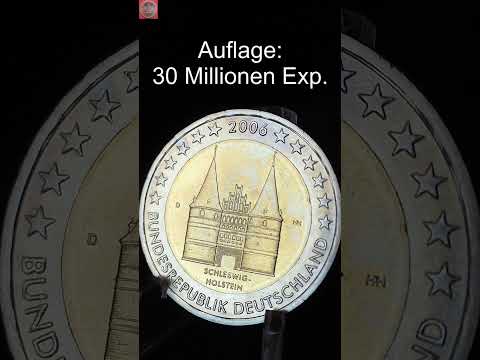 Deutschlands erste 2 Euro Sondermünze | Holstentor in Lübeck - Schles…Muenzsammler1
-
 #lübeck #hansestadt #holstentor #mittelalter @schleswigholsteintvUhlenhorster Reisedienst
-
 Lübeck, Germany 🇩🇪, The HolstentorLois von Berge
-
 Lübeck - HolstentorArchitektur TV
-
 Lübeck mit Hund | Städtetrip zur Holstentor & BacksteingotikEmmas-Pfoten-Abenteuer
-
 Holstentor Lübeck 2025moe.studio
History
The surviving building was the Middle Holsten Gate, one of four successive gates bearing the Holsten name. It strengthened the city’s defences as firearms and cannons spread.
- 1464–1478City architect Hinrich Helmstede began the gate in 1464. Built on a seven-metre mound, it was completed in 1478; the south tower began sinking into marshy ground during construction.
- 1853The outer Holsten Gate was demolished to make room for Lübeck’s first railway station and tracks.
- 1863Citizens chose restoration over demolition by a single vote.
- 1865–1870Restoration work repaired the terracotta bands.
- 1933–34The gate was stabilized with reinforced concrete anchors and iron rings. Nazi authorities converted it into the Hall of Honor and Glory museum.
Show all
- 1950The gate began housing Lübeck’s city history museum.
- 1987The gate and Lübeck’s old city centre became a UNESCO World Heritage Site.
- 2002Museum rooms were redesigned around image and sound documentation.
- 2005–2006The gate underwent its most recent restoration.
How to get there
- On footApproach from Lübeck’s main railway station via Puppenbrücke toward Holstentorplatz, at the western entrance to the old town.
- TrainThe gate is near Lübeck Hauptbahnhof and the ZOB bus terminal.
Sources: Holsten Gate - Wikipedia · Holsten Gate - Wikipedia (part 2) · Lübeck - Wikivoyage (see) · Startseite - Museum Holstentor - Die Lübecker M… · Startseite - Museum Holstentor - Die Lübecker M… · Datenschutz - Museum Holstentor - Die Lübecker … · Holstentor - Wikipedia · Holstentor - Wikipedia · checked 28 Sep 2026
- Website
- museum-holstentor.de/
- Phone
- +494511224129
Questions and answers
Did Holstentor originally contain a torture chamber?
No. A torture chamber once formed part of the museum display, but the gate never contained one.
Is Holstentor’s portcullis original?
No. It was installed in 1934 and was not part of the gate’s original defences.
What else is near Holstentor?
Fritz Behn’s bronze Striding Antilope stands across the street from the lions.
- See who's going — faces, not ticket counts.
- Write to someone who shares your interests — no swipes, no matches, no paywall.
- Pick the event or the place to meet at — and go together.