

 Photo: No machine-readable author provided. Aloriel~commonswiki assumed (based on copyright claims). · CC BY-SA 3.0 · edited
 Photo: Aloriel · CC BY-SA 3.0 · edited
 Photo: Emilio J. Rodríguez Posada · CC BY-SA 2.0 · edited
 Photo: Luis Rogelio HM · CC BY-SA 2.0 · edited
 Photo: www.pmrmaeyaert.com · CC BY-SA 3.0 · edited
 Photo: Emilio J. Rodríguez Posada · CC BY-SA 2.0 · edited
 Photo: Uther McUther · CC BY-SA 4.0 · edited
 Photo: Mon Lerma · CC BY-SA 3.0 es · edited
 Photo: ThomasPetrasch · CC BY-SA 4.0 · edited
 Photo: Laura Padilla Ortín · CC BY-SA 4.0 · edited
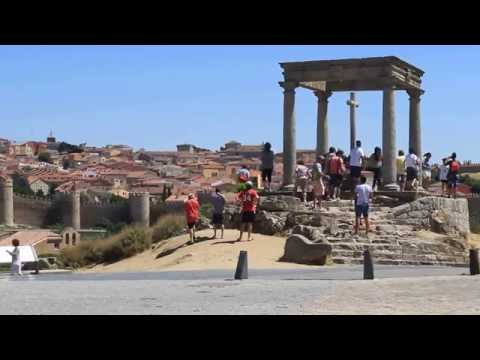
Los Cuatro Postes
Sign up free — See who's going and message them.
About
More photos 9
1 / 9 Aloriel · CC BY-SA 3.0 · edited
Why go
- Views across Ávila, its city wall and defensive towers.
- The spot where tradition says Teresa de Jesús and her brother Rodrigo were stopped as children while setting out to seek martyrdom.
Don't miss
- Ávila’s coat of armsLook for Ávila’s coat of arms on each of its four sides.On the architrave linking the columns.
- Central granite crossThe cross stands on a pedestal at the centre of the square formed by the columns.Between the four columns.
Know before you go
- Open 24 hours every day.
Interesting facts4
-

The four Doric columns have capitals and form a square.
Cuatro Postes - Wikipedia -
 1566
The 1566 commission called the monument the shrine of the bridge of the Adaja.
Los Cuatro Postes - Wikipedia -

Tradition says Teresa removed her sandals here and said, “De Ávila, ni el polvo”.
Los Cuatro Postes - Wikipedia -

In the legend, El Monje was tonsured, wore no habit and was not a religious figure.
Los Cuatro Postes - Wikipedia
Shorts


History
The town council built a shrine along the pilgrimage route as a resting place for officials. Rodrigo Dávila commissioned stonemason Francisco de Arellano to build the present monument. The 1566 design included a statue of San Sebastián and a small roof. A legend says El Monje came here with three young women and built the fourth column. Their admiration for the setting then inspired him to strengthen the structure.
- 1157Tradition says Ávila residents made a pilgrimage to the now-vanished San Leonardo hermitage to pray for the plague to end.
- Annual pilgrimageThe town council made the pilgrimage to San Leonardo an annual event.
- 1995The granite cross was replaced after vandalism destroyed it.
Sources: Los Cuatro Postes - Wikipedia · Cuatro Postes - Wikipedia · Los Cuatro Postes - Wikipedia · checked 29 Sep 2026
Questions and answers
Why was a shrine built along this route?
The council built it as a resting place for officials on the pilgrimage route to the former San Leonardo hermitage.
What saying is associated with Teresa here?
According to tradition, she removed her sandals here and said, “De Ávila, ni el polvo”.
Was El Monje a monk?
Despite his name and tonsure, the legendary figure wore no habit and was not a religious figure.
- See who's going — faces, not ticket counts.
- Write to someone who shares your interests — no swipes, no matches, no paywall.
- Pick the event or the place to meet at — and go together.