

 Photo: Vitor Oliveira from Torres Vedras, PORTUGAL · CC BY-SA 2.0 · edited
 Photo: Philip Mallis from Melbourne · CC BY-SA 4.0 · edited
 Photo: Iantomferry · CC BY-SA 3.0 · edited
 Photo: Philip Mallis from Melbourne · CC BY-SA 4.0 · edited
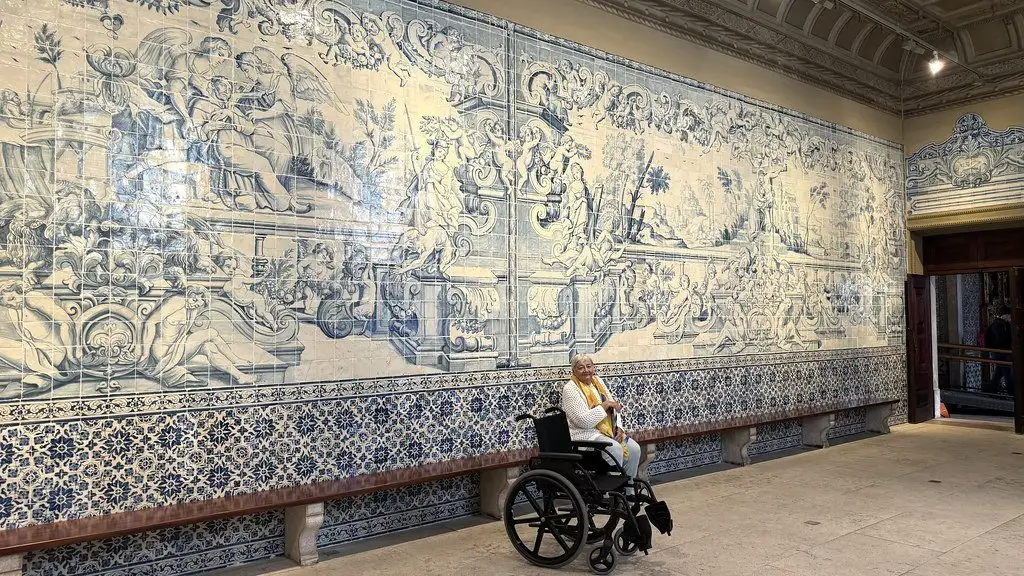 Photo: John Leeson TO · CC BY 2.0 · edited
 Photo: Philip Mallis from Melbourne · CC BY-SA 4.0 · edited
 Photo: John Leeson TO · CC BY 2.0 · edited
 Photo: John Leeson TO · CC BY 2.0 · edited
 Photo: John Leeson TO · CC BY 2.0 · edited
 Photo: Philip Mallis from Melbourne · CC BY-SA 4.0 · edited
 Photo: Ray in Manila · CC BY 2.0 · edited
 Photo: Leonie Bourke · CC BY-SA 4.0 · edited
National Tile Museum
Sign up free — See who's going and message them.
About
More photos 11
1 / 11 Philip Mallis from Melbourne · CC BY-SA 4.0 · edited
Why go
- Decorative tiles span from the second half of the 15th century to today.
- 19th- and 20th-century ceramics, porcelain and faience accompany the tile collection.
Opening hours
Today10:00 – 18:00Show all
Don't miss
- Lisbon panorama panelA 25-metre panorama depicts Lisbon 25 years before the 1755 earthquake and comprises 1,300 tiles.Second floor
- Nossa Senhora da VidaA 1580 panel depicts the birth of Jesus across more than 1,300 tiles.
- Tile portraits of Charles II and Catherine of BraganzaA series portrays the English king and his Portuguese wife.
- Madre de Deus churchDutch tile panels, a coffered ceiling, gilded woodwork and paintings decorate the church.Ground floor
- High choirRichly carved and gilded wood ornaments the former convent’s high choir.First floor
Know before you go
- The museum is currently closed for works. No reopening date is provided.
What's inside
- The permanent exhibition is arranged across three floors; the museum is currently closed.
- First floor: galleries of 17th- to 20th-century tiles, the Chapel of Saint Anthony and the choir.
Tips for your visit
- When the museum reopens, begin with the introduction to tile-making materials and techniques. Then follow the exhibition in chronological order.
Interesting facts4
-

An on-site workshop restores tile panels.
Museu Nacional do Azulejo - Wikipedia -

The collection includes tiles from the Arab world and Europe, including Delft tiles.
Musée national de l'Azulejo - Wikipedia -

The sacristy contains a Brazilian wood display cabinet and carved wooden frames holding paintings.
National Museum of the Azulejo - Wikipedia -

The Chapel of Saint Anthony has 18th-century Baroque decoration and canvases by André Gonçalves.
National Museum of the Azulejo - Wikipedia
Shorts

History
João Miguel dos Santos Simões oversaw the transfer, assembly and organization of the tile collection at the convent. The museum later expanded room by room into spaces previously occupied by the asylum’s workshops.
- 1509Queen D. Leonor founded the Madre de Deus Convent. Éléonore de Viseu was the sister of Manuel I and widow of Jean II.
- 1686Dutch tile panels were installed in the church.
- 1755The earthquake damaged the church, destroyed its main altar and brought down ceiling paintings. The two-storey Renaissance cloisters survived.
- 1834The convent was secularized after the dissolution of religious orders; the buildings subsequently served as an asylum.
- 1896Restoration began to adapt the building for the Asilo D. Maria Pia.
Show all
- 1980The museum received national status and became effectively independent of the Museu Nacional de Arte Antiga.
How to get there
- BusBuses 718, 742, 794 and 759 serve the museum at Rua da Madre de Deus 4.
Sources: National Museum of the Azulejo - Wikipedia · Lisbon/Alfama - Wikivoyage (see) · Museu Nacional do Azulejo · Museu Nacional do Azulejo - Wikipedia · Musée national de l'Azulejo - Wikipedia · Museu Nacional do Azulejo - Wikipedia · checked 28 Sep 2026
- Website
- museunacionaldoazulejo.pt/
- Phone
- +351218100340
Questions and answers
What are the National Tile Museum’s opening hours?
The museum is currently closed for works; no reopening date has been supplied. Its regular hours are Tuesday–Sunday, 10:00–18:00.
Who founded the National Tile Museum’s convent?
Queen D. Leonor founded it. She was the sister of King Manuel I and widow of King João II.
How do I get to the National Tile Museum?
Buses 718, 742, 794 and 759 serve the museum at Rua da Madre de Deus 4 in Lisbon.
- See who's going — faces, not ticket counts.
- Write to someone who shares your interests — no swipes, no matches, no paywall.
- Pick the event or the place to meet at — and go together.