


Niagara Falls
- Ideal for couples
Sign up free — See who's going and message them.
About
More photos 11
1 / 11


Why go
- The falls have the highest flow rate of any waterfall in North America.
- Horseshoe Falls stands about 57 metres high and spans about 790 metres.
- An iron scow has remained trapped on rocks above the falls since August 6, 1918.
Don't miss
- Horseshoe FallsAlso known as the Canadian Falls, this is the largest cascade, crossed by the international border.US–Canada border
- American FallsA rockfall in 1954 created the debris slope that obscures much of its drop.United States
- Bridal Veil FallsGoat Island separates it from Horseshoe Falls, and Luna Island separates it from American Falls.United States
- Maid of the MistBoat trips at the falls have operated since 1846.Niagara Falls
- Cave of the WindsA walking trail on the US side offering views of the falls.United States
History
By the mid-19th century, tourism was the area’s main industry. In the 1870s, access was limited and sightseers often paid to see the falls. Frederic Edwin Church, Frederick Law Olmsted and Henry Hobson Richardson led the US conservation movement. The 1887 park plan called for scenic roads, paths and a few shelters to protect the landscape while admitting visitors. The first hydroelectric station began operating in 1881, followed by a large alternating-current system in 1895. The Adams Power Plant Transformer House remains a landmark of the original hydroelectric system.
- 12,000 years agoRetreating glaciers formed the Niagara River and began forming the falls.
- 1750Daniel Joncaire built a canal to run a sawmill, first harnessing the falls’ power.
- 1762Thomas Davies surveyed the area and painted the first eyewitness image of the falls.
- 1881The first hydroelectric station on the Niagara River began operating, generating electricity for mills and village streets.
- 1885The Niagara Reservation became New York’s first state park.
Show all
- 1895A large alternating-current system at the falls was activated on August 26.
- 1961The Niagara Falls hydroelectric project went online as the Western world’s largest hydropower facility.
- 1969Engineers diverted the river from American Falls for five months to study the riverbed and strengthen faults against erosion.
Tips for your visit
- For a view from a bridge, use the Rainbow Bridge just downstream of the falls; it offers the closest view from a bridge.
How to get there
- CarThe falls lie 27 kilometres northwest of Buffalo and 69 kilometres southeast of Toronto.
- On footVisitors can cross the Rainbow Bridge on foot.
- CarVisitors can cross the Rainbow Bridge in a non-commercial vehicle.
Shorts
-
 Must things to do in Niagara Falls | Travel GuideJeenia & Ionut
-
 Why Niagara Falls Canada Has More Skyscrapers Than The US SideBig Tall In Short
-
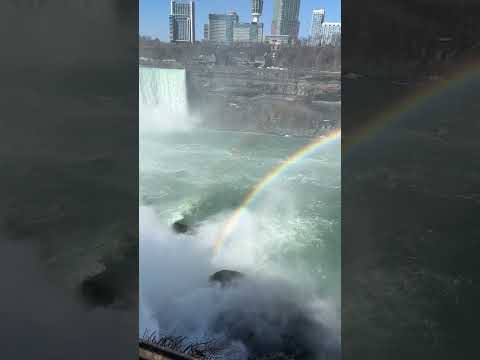 Niagara Falls New Yorkgracieshotstuff
-
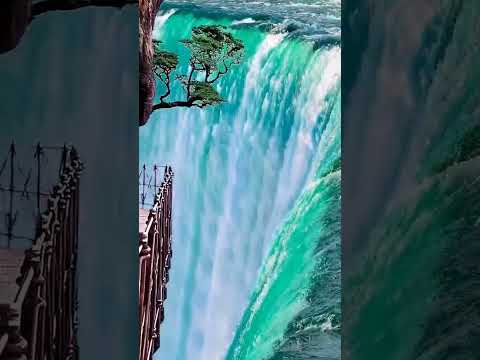 NIAGARA FALLS - ONTARIO, CANADA 4KRoaming the Globe
-
 Top-5 things to do at Niagara Falls (USA side)Olala USA
-
 Niagara Falls Top 10 Attractions! ⭐️⭐️⭐️⭐️⭐Brandon’s Travel Guides
-
 The best view of Niagara FallsJake and Kaylee
-
 Things to do in Niagara Falls in a day!!Clifton Hill Niagara Falls
Interesting facts7
-
 21 and
American Falls drops between 21 and 30 metres because boulders lie at its base.
Niagara Falls - Wikipedia -
 168,000 cubic
At peak daytime tourist times, more than 168,000 cubic metres of water pass over the crest each minute.
Niagara Falls - Wikipedia -
 1848
In 1848, an ice jam stopped the flow of the river and falls temporarily.
Niagara Falls - Wikipedia -
 2.4 gigawatts
The New York power complex can generate 2.4 gigawatts, making it the state's largest electricity producer.
Niagara Falls - Wikipedia -
 5 kilometres
The Niagara Whirlpool formed during the falls' retreat and lies about 5 kilometres downstream.
Niagarafälle - Wikipedia -
 1950
A 1950 treaty sets minimum flows over the falls to preserve their natural appearance.
Niagara Falls - Wikipedia -

Power plants divert some river water through tunnels beneath Niagara Falls city to two power stations downstream.
Niagara Falls - Wikipedia
Sources: Niagara Falls - Wikipedia · Niagara Falls (New York) - Wikivoyage (do) · Niagarafälle - Wikipedia · Chutes du Niagara - Wikipedia · checked 30 Sep 2026
Plan from here: Evening walk →
Questions and answers
Why is there rock debris below American Falls?
A major rockfall in 1954 created the slope. A proposal to remove it was abandoned because the debris helps stabilise the cliff.
Did all three Niagara Falls waterfalls freeze in 1912?
American Falls froze completely, while the other two waterfalls kept flowing.
Can you get married at Niagara Falls?
Weddings can take place at the Top of the Falls restaurant or in the park year-round.
Where does the name Niagara come from?
It may come from the Iroquoian word Onguiaahra, but the name’s origin is unsettled.
- See who's going — faces, not ticket counts.
- Write to someone who shares your interests — no swipes, no matches, no paywall.
- Pick the event or the place to meet at — and go together.