
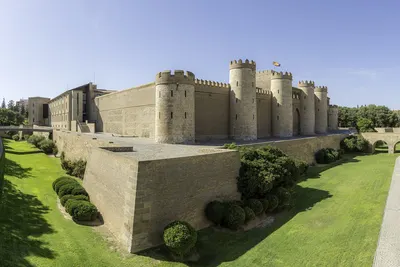

Palacio de la Aljaferia
- from EUR 5
Sign up free — See who's going and message them.
About
More photos 11
1 / 11


Why go
- Restored original structures included in the Mudéjar Architecture of Aragon World Heritage Site in 2001.
- The Throne Room’s 20-by-8-metre ceiling, with eight-pointed stars and thirty deep square coffers.
- The small private mosque’s mihrab, oriented toward Mecca, and its gallery’s surviving 11th-century pictorial decoration.
- The south portico’s interlocking mixtilinear arches, first used here before spreading to other Islamic buildings.
Interesting facts5
-

Al-Muqtadir called the palace Qasr al-Surur, or Palace of Joy.
Aljafería - Wikipedia -
 1836
The Troubadour Tower takes its name from Antonio García Gutiérrez’s 1836 drama, later adapted into Verdi’s opera Il trovatore.
Palacio de la Aljafería - Wikipedia -

The palace’s stucco reliefs originally had red and blue backgrounds with raised gold decoration.
Palais de l'Aljaferia - Wikipedia -

The Golden Hall was Al-Muqtadir’s throne room, where he held receptions and received embassies.
Aljafería - Wikipedia -

Royal coronation and oath processions started at the palace and continued to Zaragoza’s Cathedral of the Savior.
Aljafería - Wikipedia (part 2)
Shorts
-
 Palacio de la Aljafería, Zaragoza.Cartografía Digital
-
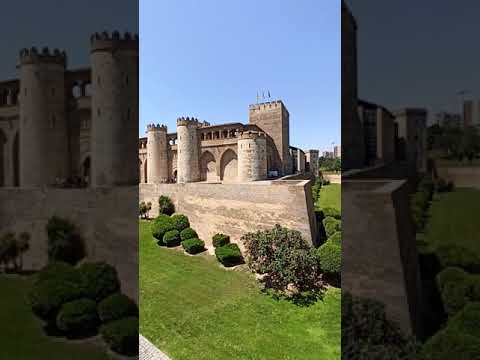 Palacio aljaferia Zaragoza 🇪🇦 قصر الجعفرية سرقسطةtraveleasy92
-
 Palacio de Aljafería | aljafería palace, Zaragoza, SpainWalk With AL
-
 Palacio de la Aljafería 💕P. de la Humanidad - Zaragoza Adela Fernandez Perez - Mis viajes -
-
 🏰 Palacio de la Aljafería -Travelers MX
-
 Avance de Electro Nature en el Palacio de la Aljafería (Zaragoza/Espa…Electro Nature
Photo spots
- Gilded ceilings of the lost-steps roomsThese former royal waiting rooms have carved wooden ceilings made by Aragonese Mudéjar carpenters and gilded with gold leaf. Only two of the three rooms are accessible during replacement of the mosque dome.The two accessible rooms of the lost steps
- Throne Room entrance portalThe plaster portal has a five-lobed tympanum and the Catholic Monarchs’ coat of arms.At the entrance to the Throne Room
History
- 9th centuryThe palace’s oldest component, the Troubadour Tower, originated in this period; its lower floors survive.
- 1065–1081Al-Muqtadir commissioned the Taifa palace, mostly built during these years.
- 1118After Zaragoza was conquered, the palace became a residence of Aragón’s Christian kings.
- 1336Peter IV expanded the palace and built the Chapel of San Martín in the entrance courtyard.
- 1486The Courtyard of San Martín became the Inquisition’s headquarters, and the Troubadour Tower became its prison.
Show all
- 1488–1495Mudéjar masters built the Catholic Monarchs’ upper-floor state rooms above the existing palace; an inscription records the monarchs’ order in 1492.
- 1591An uprising attacked the palace to free Antonio Pérez.
- 1593Philip II ordered the palace fortified as a citadel.
- 1772Charles III began converting the complex into barracks.
- 18th–19th centuriesPrisoners left graffiti in the Tower of the Troubadour.
- 1947Restoration began under architect Francisco Íñiguez.
- 1987The Cortes of Aragón began meeting in a hall on the palace’s southeast side.
How to get there
- BusCalle de los Diputados, s/n, Zaragoza. Buses 32, 34 and 36 run here from the city centre.
Sources: Aljafería - Wikipedia · Aljafería - Wikipedia (part 2) · Aljafería - Wikipedia (part 3) · Zaragoza - Wikivoyage (see) · Compra y Reserva de Entradas · Palacio de la Aljafería - Wikipedia · Aljafería - Wikipedia · Palais de l'Aljaferia - Wikipedia · checked 28 Sep 2026
- Phone
- +34 976 28 96 83
Questions and answers
Where does Palacio de la Aljafería’s name come from?
It derives from Abu Ya’far, a name used by its builder, Al-Muqtadir.
How do visitors reach the upper palace rooms?
A monumental staircase leads from the ground-floor courtyard to a first-floor gallery and the Throne Room.
What was distinctive about the waiting-room floors?
They combined colourful hexagonal ceramic pieces with square azulejos made at Loza de Muel in the late 15th century.
What survives of Palacio de la Aljafería’s later barracks?
The western additions still shape the complex and now serve administrative purposes.
When is Palacio de la Aljafería open?
Daily, 10:00–17:15.
- See who's going — faces, not ticket counts.
- Write to someone who shares your interests — no swipes, no matches, no paywall.
- Pick the event or the place to meet at — and go together.