
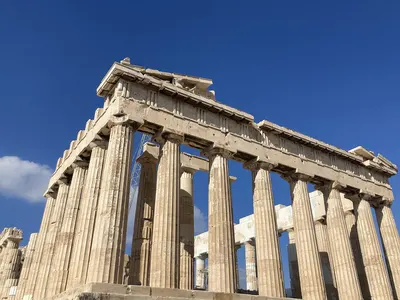

Parthenon
Sign up free — See who's going and message them.
Is this your place? Get the badge for your websiteAbout
More photos 11
1 / 11


Why go
- The outer colonnade of 46 Doric columns: eight at each end, seventeen along each side.
- The Doric design that many nations copied for parliaments, assemblies and law courts.
- The Ionic frieze around the outside of the cella walls, about 160 m long, shows a real event rather than a myth.
Opening hours
Today00:00 – 23:59Show all
Don't miss
- Helios and Selene corner groupsOnly two corner groups survive from the east pediment: Helios on the left and Selene on the right. The pediment once showed the birth of Athena.East end, above the main entrance On the map
- West pediment statuesThe west pediment showed Athena's contest with Poseidon for the land. Every statue in it has a finished back, which could not be seen once in place.West end of the temple On the map
- The metopesThe 92 metopes were carved in high relief, and nine are lost. The east ones show gods against Giants, the west Athenians against Amazons, the south Lapiths against Centaurs.Along the top of the outer colonnade; the pin marks the south side On the map
Know before you go
- Open every day, around the clock.
Tips for your visit
- The address is Acropolis Top, Dionyssiou Areopagitou, Athens.
- It stands among the main Acropolis buildings, with the Propylaia, Erechtheion and Temple of Athena Nike.
- Only a few original sculptures are still on the building; most are in the Acropolis Museum and the British Museum.
- Other pieces are in the Louvre, the National Museum of Denmark and the Kunsthistorisches Museum in Vienna.
- Millions of visitors from around the world come every year.
With kids
- Lion heads at the corners of the temple served as gargoyles.
- The pediments once showed the birth of Athena and her battle with Poseidon for control of Athens.
- The Poseidon statue was the largest pediment sculpture until it broke during a removal attempt in 1688.
Interesting facts8
-

The name most likely comes from parthénos, the Greek word for maiden or virgin.
Parthenon - Wikipedia -

Iktinos and Callicrates seem to have called it 'the hundred footer'.
Parthenon - Wikipedia -
 8,480 flat
The roof was covered with 8,480 flat marble tiles, each weighing about 50 kg.
Parthénon - Wikipedia -

The triglyphs are about 858 mm wide, a unit Ernst Berger found recurring in the building's main dimensions.
Parthenon - Wikipedia -

The steps curve: the middle sits 6.75 cm above the ends.
Parthénon - Wikipedia -

The columns bulge about 4 cm a third of the way up, an optical refinement called entasis.
Parthénon - Wikipedia -

The mathematician Alain Goriely calls these optical refinements one of history's most enduring myths.
Parthenon - Wikipedia -

The main front faces east, which is unusual for Doric temples.
Parthénon - Wikipedia
Shorts
-
 Parthenon :🏛️ The Temple That Defined CivilizationLetsTourEarth
-
 Why is the Parthenon is such an important structure?Urbanist Ariel
-
 ACROPOLIS, Greece Walking Tour with ParthenonHP Walking Tours
-
 The Strange Detail Hidden in the ParthenonMaze Runner
-
 Inside the Parthenon | Athena ParthenosNerdyGirl Travels
-
 The Acropolis of Athens: Greece’s Timeless WonderXYTerra
-
 The (real) beauty of the ParthenonHannah Fry
-
 How the Parthenon Became the Ruin We KnowOne Square
History
The Parthenon was built in the 5th century BC to thank Athena for the Greek victory over the Persian invaders. For a time it was the treasury of the Delian League, which later became the Athenian Empire. Like most Greek temples, it also held the city's treasure.
- 447 BCPericles starts the new temple, designed by Iktinos and Callicrates, with Phidias overseeing the sculpture.
- 438 BCThe temple is completed and dedicated to Athena, while work on its decoration goes on into the 430s BC.
- 6th century ADIn the final decade of the 6th century AD, the temple becomes a church dedicated to the Virgin Mary.
- 1460After the Ottoman conquest, the temple is turned into a mosque.
- 1687A Venetian bomb hits the temple while the Ottomans store ammunition inside, and the blast badly damages it.
Show all
- 1800–1803The 7th Earl of Elgin removes many of the surviving sculptures and ships them to England.
- 1832The newly founded state takes control of the hill and declares it an archaeological site.
- 1975Large-scale restoration projects begin to preserve what remains and keep it structurally sound.
Sources: Parthenon - Wikipedia · Athens - Wikivoyage (see) · Parthenon - Wikipedia · Παρθενώνας - Wikipedia · Parthénon - Wikipedia · checked 17 Oct 2026
- Phone
- +30 21 0321 4172
Questions and answers
Where is the Parthenon in Athens?
It stands on the Acropolis hill in Athens, beside the Propylaia, the Erechtheion and the Temple of Athena Nike.
Is the Parthenon still being repaired?
Large-scale restoration projects have been under way since 1975, aiming to preserve what survives and keep the structure sound.
What does the name Parthenon mean?
The name most likely comes from parthénos, the Greek word for maiden or virgin, though its origin is not fully settled.
Why is the Parthenon so famous?
Many nations copied it for their parliaments, assemblies and law courts. It is also seen as a symbol of ancient Greece, Western civilisation and democracy.
How many people visit the Parthenon each year?
Millions of people from around the world visit it every year.
- See who's going — faces, not ticket counts.
- Write to someone who shares your interests — no swipes, no matches, no paywall.
- Pick the event or the place to meet at — and go together.