

 Photo: Holger Uwe Schmitt · CC BY-SA 4.0 · edited
 Photo: Holger Uwe Schmitt · CC BY-SA 4.0 · edited
 Photo: Holger Uwe Schmitt · CC BY-SA 4.0 · edited
 Photo: Holger Uwe Schmitt · CC BY-SA 4.0 · edited
 Photo: Holger Uwe Schmitt · CC BY-SA 4.0 · edited
 Photo: Holger Uwe Schmitt · CC BY-SA 4.0 · edited
 Photo: Holger Uwe Schmitt · CC BY-SA 4.0 · edited
 Photo: Mark Sehnert · Public domain · edited
 Photo: Frédéric Neupont · CC BY-SA 4.0 · edited
 Photo: Holger Uwe Schmitt · CC BY-SA 4.0 · edited
 Photo: Holger Uwe Schmitt · CC BY-SA 4.0 · edited
 Photo: Gerd Eichmann · CC BY-SA 4.0 · edited
Piazza del Campo
Sign up free — See who's going and message them.
About
More photos 11
1 / 11 Holger Uwe Schmitt · CC BY-SA 4.0 · edited
Why go
- The Palio horse race circles the square on 2 July and 16 August.
- Fonte Gaia’s rectangular basin has reliefs of the Madonna and the Virtues.
- Torre del Mangia rises 102 metres beside Palazzo Pubblico.
Don't miss
- Red brick pavingNine herringbone-patterned wedges are divided by white bands and point toward Palazzo Pubblico.Across the square’s central area
- GavinoneA sculpture by Massimo Lippi decorates the drain at the square’s lowest point.At the square’s low point
Photo spots
- Fonte GaiaPhotograph the fountain’s basin and its reliefs of the Madonna and the Virtues.At the northwest edge of the square On the map
Interesting facts2
-
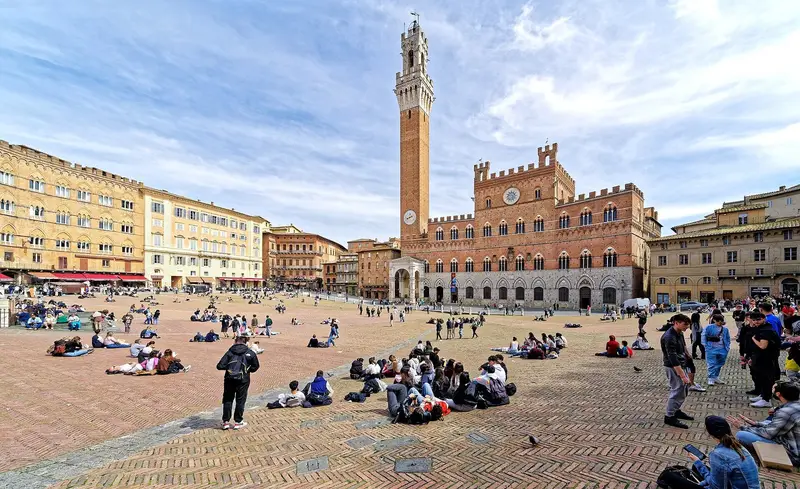
The square’s scooped paving collects rainwater and channels it to the low point called the Gavinone.
Piazza del Campo - Wikipedia -

The governing families’ palaces shared unified rooflines, intended to convey decorum and contrast with earlier tower houses.
Piazza del Campo - Wikipedia
Shorts
-
 No.6 🇮🇹 Piazza del Campo ✨ The Heart of Siena 🏰 Aerial View of Italy’…Journunney
-
 Siena - Piazza Del CampoJohn B
-
 Piazza del Campo, SIENA | Tuscany | ITALYEnchanted Travelling
-
 Tiramisu at Piazza Del Campo, a SienaJun‘a Pocha | Food & Travel
-
 Piazza del Campo. Siena, ItalyItaly by Me
-
 Siena’s Piazza del Campo: A Beautiful MomentJuvi Johal
-
 Piazza del Campo | SienaShuviy in Short
-
 Amazing Siena Piazza del Campo RidePodium Physio
History
The site began as open land at a crossroads, used for markets and public gatherings. By 1169, the Campo name was recorded and the community had acquired land for the square. Rules for its buildings followed in 1297. The Palazzo Pubblico and Torre del Mangia anchor the square. It was fully paved in 1349, while Fonte Gaia commemorates Siena’s first successful water supply.
- Before the 13th c.The open site served as a gathering place, marketplace and venue for games, fights and races.
- 1169The Campo name appeared in a record, and the community acquired land for the square.
- 1193The Campo and market square had been separated.
- 1297The municipality set rules for buildings facing the square, including window requirements.
- 1325–1344The Torre del Mangia was built.
Show all
- 1342Water reached Siena through a 25-kilometre conduit; Fonte Gaia commemorates the supply.
- 1349The square was fully paved and divided into nine sections.
- 1419Jacopo della Quercia sculpted the original Fonte Gaia.
- 1995The Historic Centre of Siena was designated a UNESCO World Heritage Site.
How to get there
- On footPiazza del Campo stands where Siena’s three main streets meet.
Sources: Piazza del Campo - Wikipedia · Piazza del Campo - Visit Siena Official · Piazza del Campo - Wikipedia · Piazza del Campo - Wikipedia · Piazza del Campo - Wikipedia · checked 5 Oct 2026
- Phone
- +390577899728
Questions and answers
How do I get to Piazza del Campo from Siena’s centre?
It is Siena’s main square, where the city’s three main streets meet.
When is the Palio held at Piazza del Campo?
The race takes place on 2 July and 16 August each year.
- See who's going — faces, not ticket counts.
- Write to someone who shares your interests — no swipes, no matches, no paywall.
- Pick the event or the place to meet at — and go together.