

 Photo: Thomas Wolf , www.foto-tw.de · CC BY-SA 3.0 de · edited
 Photo: Lsjm · CC BY-SA 4.0 · edited
 Photo: Flocci Nivis · CC BY 4.0 · edited
 Photo: Jean Housen · CC BY 3.0 · edited
 Photo: MHM55 · CC BY-SA 4.0 · edited
 Photo: MHM55 · CC BY-SA 4.0 · edited
Porta Nigra
Erwachsene EUR 6 · Erwachsene mit Ermäßigt* EUR 5 · Kinder / Jugendliche (6-18 Jahre) EUR 3
Sign up free — See who's going and message them.
About
More photos 11
1 / 11 Lsjm · CC BY-SA 4.0 · edited


Why go
- Delicate Baroque reliefs inside the Roman monument.
Plan your visit
Prices
From the venue's website · checked 22 Nov 2026
Opening hours
Today09:00 – 16:00Show all
Don't miss
- Unfinished façadeLook for the rough, unworked half-columns on the countryside-facing side.Outer façade facing the countryside.
- Interior contrastsExplore the bright upper-floor passageways and the dark ground-floor rooms.Upper floors and ground floor.
- Southern colonnadeFollow the Roman columns along the final 100 metres of the southern approach, tracing the former colonnade.Southern approach, along the final 100 metres of the street.
Know before you go
- Open daily, 09:00–16:00.
Tips for your visit
- Restoration is expected to continue until 2028. Some sections are scaffolded, but the gate remains open to visitors.
With kids
- In summer, a costumed Roman centurion leads a role-play tour involving defending the gate and trying a soldier’s routine.
Interesting facts5
-
 7,200 stone
Builders used about 7,200 stone blocks, some weighing up to six tonnes.
Porta Nigra - Wikipedia -

The original design had two four-storey towers and two gate openings divided by a narrow courtyard.
Porta Nigra - Wikipedia -

Stonecutters’ marks, some upside down, probably helped masons position the blocks.
Porta Nigra - Wikipedia -

Researchers generally regard the gate as a monumental peacetime project rather than chiefly a defensive structure.
Porta Nigra - Wikipedia -

Its shell is estimated to have taken two to four years to build, although the monument remained unfinished.
Porta Nigra - Wikipedia
Shorts
-
 Porta Nigra Trier-Rheinland-Pfalz. 2 Euro Deutschland 2017.Münzensammler_AL
-
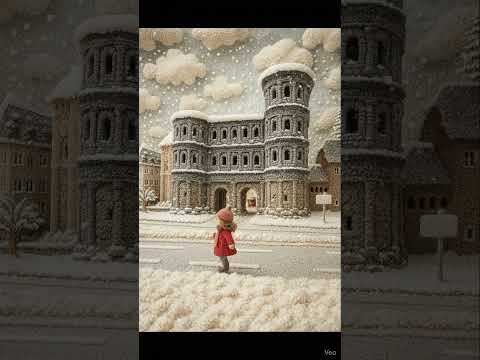 Trier, wie du es noch nie gesehen hast! ❄️🧶 Porta Nigra im WinterArtience. io
-
 Deutschland 🇩🇪, 2 Euro Münze „Porta Nigra Trier - Rheinland-Pfalz“ 20…Münzensammler_AL
-
 Germany 2 euro, 2017 Porta Nigra, Rhineland-Palatinate | RHEINLAND-PF…ROI DES PIECES
-
 Exploring Porta Nigra Germany’s Ancient Roman GateKevEngineered
-
 Porta Nigra in Germany’s oldest town of Trier.ReKlein Life
-
 Porta Nigra in Trier Germany | 1842 years old!Safar 1001
-
 Porta Nigra und Karl Marx in Trier.Ingwar Lattke
History
Of Roman Trier’s four city gates, Porta Nigra is the only one still standing.
- c. 170 CEConstruction began at the northern entrance to Augusta Treverorum. The gate was never fully completed.
- 1028–1035The monk Simeon lived as a hermit in the gate from 1028 and was buried on its ground floor in 1035.
- 11th centuryArchbishop Poppo converted the gate into an upper church for monks and a lower church for the public. This helped preserve it from being dismantled. A smaller city gate, the Simeon Gate, stood to the east and took over the city-gate role.
- 1802–1804Napoleon closed the church and monastery in 1802, then ordered the church additions removed in 1804.
- 1804–1817Demolition ran from 1804 to 1809, with work completed in 1817. The restoration left a shortened apse and an east tower lower than its original height.
Show all
- 19th centuryAfter restoration, the building served as Trier’s first antiquities museum.
- 1822The gate reopened as a city gate on 22 May, after door leaves were installed.
- 1986Porta Nigra and other Roman monuments in Trier and its region became a UNESCO World Heritage Site.
How to get there
- On footAddress: Simeonstraße 60, Trier. The gate stands beside one of Trier’s main streets and is closed to cars.
Sources: Porta Nigra - Wikipedia · Trier - Wikivoyage (see) · Porta Nigra - Sehenswürdigkeiten - Tourist-Info… · Porta Nigra - Wikipedia · Porta Nigra - Wikipedia · checked 28 Sep 2026
- Phone
- +496514608965
Questions and answers
How much does it cost to visit Porta Nigra?
Admission is €6 for adults, €5 for reduced-rate adults, €3 for children and teenagers aged 6–18, and €5 per adult in groups of 10 or more.
Why is Porta Nigra called Porta Nigra?
The medieval name refers to its darkened stone; its original Roman name is unknown.
- See who's going — faces, not ticket counts.
- Write to someone who shares your interests — no swipes, no matches, no paywall.
- Pick the event or the place to meet at — and go together.