


Sintra National Palace
- from EUR 13
Sign up free — See who's going and message them.
About
More photos 11
1 / 11
 Peter K Burian · CC BY 4.0 · edited


Why go
- Two enormous white conical chimneys mark the palace skyline above the royal kitchen.
- The Coats-of-Arms Room has a wooden domed ceiling decorated with royal and noble heraldry.
- The Magpie Room features 136 magpies carrying the motto “por bem.”
Opening hours
Today00:00 – 23:59Show all
Don't miss
- Royal ChapelLook for carpet-like tile patterns on the apse floor, dove paintings on the walls and Moorish latticework overhead.
- Swan Room ceilingLook up at the swans painted across the ceiling.
- Arab RoomLook for the Moorish-style fountain at the centre of the tiled room.
Know before you go
- Private vehicles in Sintra’s historic centre are restricted to residents. Park outside the restricted area and continue on foot or by public transport.
Interesting facts3
-

A gravity-fed system carries spring water from the Sintra mountains through galleries, aqueducts and rock tunnels.
Palácio Nacional de Sintra - Wikipedia -

The palace is part of the Cultural Landscape of Sintra, a UNESCO World Heritage Site.
Sintra National Palace - Wikipedia -

The Távora family’s coat of arms was removed after the family’s conspiracy against King Joseph I.
Sintra National Palace - Wikipedia
Shorts
-
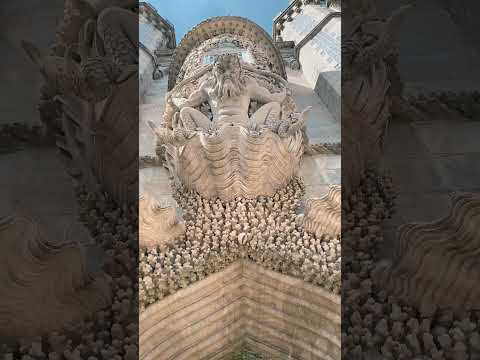 Best Day Trip from Lisbon - National Palace of PenaY Not Today - Board game and Bingsu Cafe
-
 Courtyard and Praca da República, Sintra National Palace, Lisbon dist…ed tuason
-
 Patio Central, Sintra National Palace, Lisbon district, Portugaled tuason
-
 Visiting the National Palace of Sintra, PortugalThe Filipino Traveler
History
The palace’s present Gothic, Manueline, Moorish and Mudéjar styles largely reflect 15th- and early 16th-century building work. Hunting nearby, cool summers and plague outbreaks in the capital helped make it a regular royal destination. Afonso V was born and died here, and João II was acclaimed king here. Manuel I learned of Brazil’s discovery at the palace.
- 10th–11th c.The first building was likely built during Moorish rule; its founding date is uncertain. The Moorish rulers of the Taifa of Lisbon used it as a residence.
- 12th c.King Afonso Henriques conquered Sintra and took the palace for his use.
- Early 14th c.The Royal Chapel, the oldest surviving part, may date to King Dinis I’s reign.
- Early 15th–late 19th c.The palace served as a royal residence. João I began a major building campaign around 1415.
- 1497–1530Manuel I sponsored a major building campaign and redecorated rooms with polychrome tiles made in Seville.
Show all
- 16th c.Under João III, rooms were furnished in Renaissance style.
- 1676–1683Afonso VI was imprisoned in the palace after his brother deposed him; he died there in 1683.
- 1755The Lisbon earthquake damaged the palace and collapsed the tower above the Arab Room. Damaged parts were rebuilt in the old style.
- 1910Royal summer use ended with the revolution, and the palace became a National Monument.
- 1940The palace opened as a museum.
- 1940sRaul Lino led a restoration that repaired tile panels and added old furniture from other palaces.
How to get there
- TrainFrom Lisbon, take the Sintra Line from Oriente, Rossio or Entrecampos to Sintra.
- BusFrom Sintra station, take bus 434 or 435 to the palace.
- 15 minOn footAllow 10–15 minutes on foot from Sintra station.
Sources: Sintra National Palace - Wikipedia · Sintra - Wikivoyage (see) · National Palace of Sintra - Parques de Sintra · Schloss Sintra - Wikipedia · Palais national de Sintra - Wikipedia · Palácio Nacional de Sintra - Wikipedia · checked 28 Sep 2026
- Phone
- +351219237300
Questions and answers
Why did monarchs come to Sintra National Palace?
Nearby hunting, the cool summer climate and plague outbreaks in Lisbon helped make it a regular royal destination.
Was a king imprisoned at Sintra National Palace?
After his brother deposed him, Afonso VI was confined there from 1676 until his death in 1683.
Where is Sintra National Palace relative to Castelo dos Mouros?
The palace stands downhill from Castelo dos Mouros.
- See who's going — faces, not ticket counts.
- Write to someone who shares your interests — no swipes, no matches, no paywall.
- Pick the event or the place to meet at — and go together.