
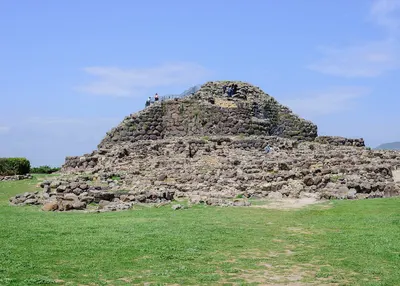

Su Nuraxi
Sign up free — See who's going and message them.
Is this your place? Get the badge for your websiteAbout
More photos 11
1 / 11


Why go
- An 18.6-metre central tower contains three stacked chambers.
- Su Nuraxi became a UNESCO World Heritage Site in 1997.
- Its position helped control a key route from Campidano into Sardinia’s interior.
- Reinforcement created a new entrance about seven metres above ground.
Opening hours
Today09:00 – 17:00Show all
Don't miss
- MastioThe central keep contains a chamber with two side niches set off-centre.Central tower
- Courtyard wellA 20-metre-deep drinking-water well lies beside the central keep.Courtyard
- Outer defensesThree surviving outwork towers once helped defend the bastion. Tower H is the best preserved and stands 4.5 metres high.Outer defensive wall
- Hut 80A bench and wall niches remain in this hut, which appears to have served as a meeting place.Village
Know before you go
- The site can be visited in guided groups.
Tips for your visit
- For orientation, the site is beside the road to Tuili, west of Barumini.
Interesting facts4
-

Su Nuraxi means “The Nuraghe” in Campidanese, a southern variety of Sardinian.
Su Nuraxi (Barumini) - Wikipedia -

The nuraghe’s purpose remains disputed; archaeologist Giovanni Lilliu supported the view that it was a fortress.
Su Nuraxi (Barumini) - Wikipedia -

Excavations uncovered tools, weapons, pottery and ornaments.
Su Nuraxi (Barumini) - Wikipedia -

Small votive wells point to a founding ritual before the village was built.
Su Nuraxi - Wikipedia
Shorts
-
 Sardinia Has 7,000 of These. Nobody Knows Who Built Them. | Su NuraxiStone Reborn
-
 What’s REALLY Inside a 3,500-Year-Old Nuraghe at Su Nuraxi di Barumin…Nomad And In Love
-
 Su Nuraxi di Barumini patrimonio UNESCOLu Ciràiu Candele Artigianali Sarde
-
 Su Nuraxi di Barumini: Sardinia's Ancient UNESCO World Heritage SiteThis Is Italy
-
 Su Nuraxi di Barumini – Video MusicaleDiversamente Sardi
-
 Nuraghe Su Nuraxi : Sardinia’s Ancient Stone FortressHistory Uncovered
-
 Stone Age Wonders: Su Nuraxi di Barumini 🏰 Pt. 2Zachk91
-
 UNESCO WORLD HERITAGE SITES - Su Nuraxi di Barumini, ItalyHerr Translator: Explore and Inspire
History
Earth deposits covered the complex until the mid-20th century.
- 17th–13th centuries BCEThe central tower was built from basalt blocks.
- Late Bronze AgeFour towers and a curtain wall were added around the central tower, and a village grew around the nuraghe.
- 9th–8th century BCEA paved square, streets and a sewerage system were built.
- Iron AgeAn additional outer wall enclosed the complex.
- 6th century BCEAfter the buildings were destroyed, Carthage restored them.
Show all
- 1st century BCEThe complex remained active during Roman rule.
- Punic–Roman periodThe courtyard gradually became a burial place, and an external cemetery was also present.
- After Roman occupationThe site was eventually abandoned.
- 1940sLarge stones and pottery led Giovanni Lilliu to suspect a major archaeological find lay beneath the earth deposits covering the complex.
- 1950sGiovanni Lilliu led excavations at the site.
- After excavationThe site opened to the public.
Sources: Su Nuraxi (Barumini) - Wikipedia · Nuraghe Su Nuraxi - Wikipedia · Su Nuraxi - Wikipedia · Su Nuraxi - Wikipedia · checked 27 Sep 2026
- Website
- fondazionebarumini.it/
- Phone
- 00390709368128
Questions and answers
Can I visit Su Nuraxi with a guide?
The site can be explored in guided groups.
What did the village homes at Su Nuraxi look like?
The circular huts had dry-stone walls and conical roofs made from wood and branches.
What activities took place in the Su Nuraxi village?
Rooms served as workshops, kitchens and agricultural-processing spaces.
How were the later homes at Su Nuraxi arranged?
Later houses had central paved atriums, sometimes with wells, and rooms for sleeping, cooking and living.
- See who's going — faces, not ticket counts.
- Write to someone who shares your interests — no swipes, no matches, no paywall.
- Pick the event or the place to meet at — and go together.