

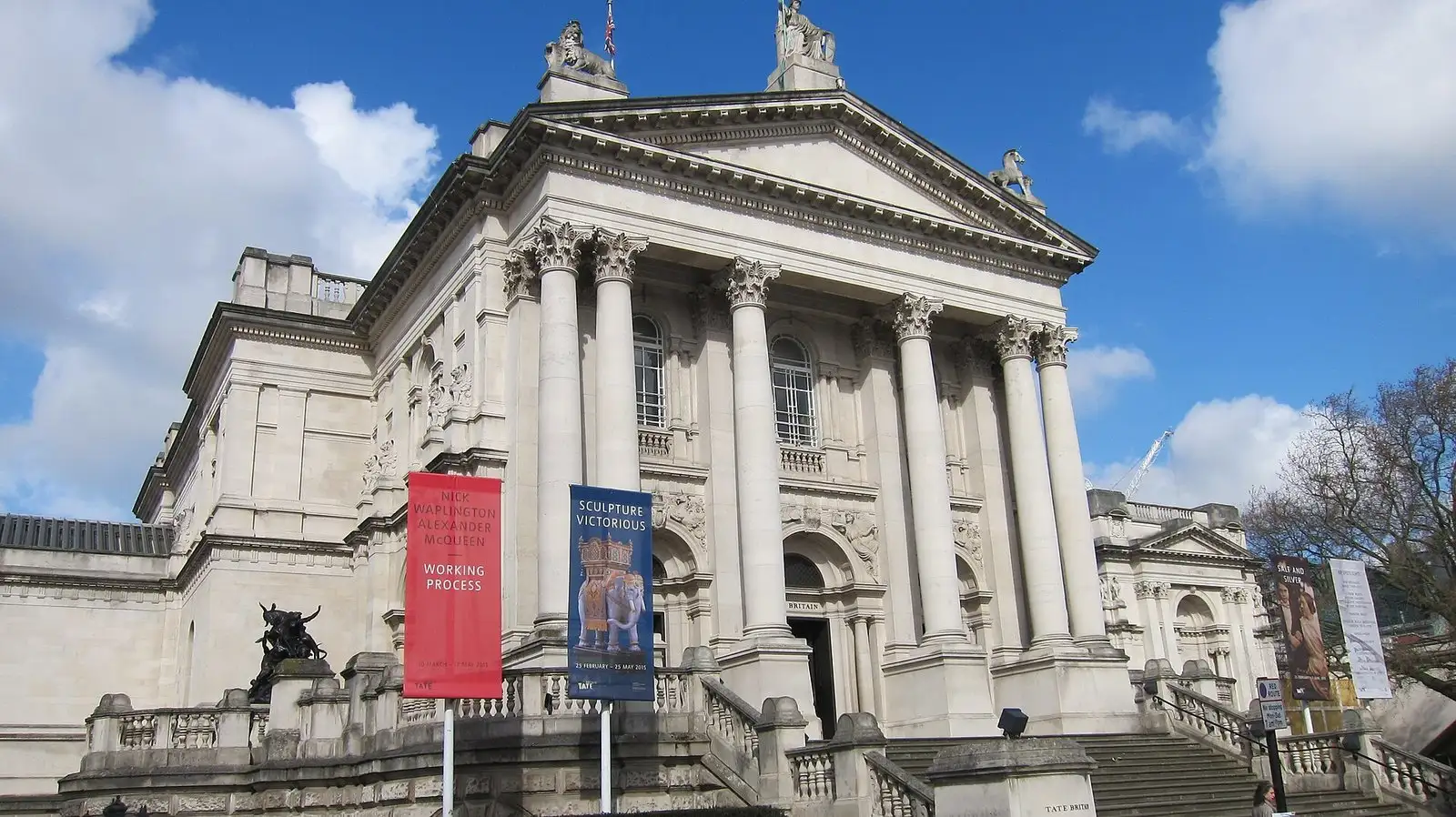
 Photo: Carlos Cunha · CC BY-SA 3.0 · edited
 Photo: Rept0n1x · CC BY-SA 3.0 · edited
 Photo: Jim Osley · CC BY-SA 2.0 · edited
 Photo: Txllxt TxllxT · CC BY-SA 4.0 · edited
 Photo: Txllxt TxllxT · CC BY-SA 4.0 · edited
 Photo: Easternhillhiphop · CC BY-SA 4.0 · edited
 Photo: amanderson2 · CC BY 2.0 · edited
 Photo: Foeromeo · CC BY-SA 4.0 · edited
 Photo: Txllxt TxllxT · CC BY-SA 4.0 · edited
 Photo: Txllxt TxllxT · CC BY-SA 4.0 · edited
 Photo: Txllxt TxllxT · CC BY-SA 4.0 · edited
 Photo: Txllxt TxllxT · CC BY-SA 4.0 · edited
Tate Britain
- Step-free access
- Ideal for kids
Sign up free — See who's going and message them.
What's on here
 Art Now: Clara Hastrup4 Dec – 16 May 2027
 Tate Britain Gallery Crawl & Coffee: Mum & Baby EditionMon, 11 Jan 2027, 10:00
Free
 Image of the Black at Tate BritainSun, 31 Jan 2027, 14:00
8 GBP
Tate Britain Gallery Crawl & Coffee: Mum & Baby EditionMon, 8 Feb 2027, 10:00
Free
 Members Private View: Vanessa Bell and Duncan Grant: Inside BloomsburyMon, 8 Feb 2027, 18:45
Free
 Members Private View: The 90 s : Art and FashionMon, 8 Feb 2027, 18:45
Free
 The 90 s : Art and FashionUntil 14 Feb 2027
Free
The 90 s : Art and FashionSun, 14 Feb 2027, 10:00
Free
About
More photos 11
1 / 11 Rept0n1x · CC BY-SA 3.0 · edited
Why go
- The world’s largest collection of British art spans the 16th to 21st centuries.
- The world’s largest free display of J. M. W. Turner paintings.
- The Turner Prize exhibition, usually held here every other year, presents work by four shortlisted artists.
- Art Now presents a temporary exhibition devoted to one contemporary artist.
Opening hours
Today10:00 – 18:00Show all
Don't miss
- Dolly and Polly Barnard lighting lanternsJohn Singer Sargent painted the sisters lighting lanterns in a garden in Broadway, working from life during a few minutes of suitable evening light.Room 8
- The Cholmondeley womenThis anonymous painting, dated 1600–1610, depicts two women from the Cholmondeley family whose identities are unknown.Room 1
- Turner’s funeral at seaTurner depicted the funeral at sea of his friend, artist David Wilkie, who died of typhoid in 1841.Room 32
- Bacon’s avenging figuresFrancis Bacon said the figures represent the Furies of Greek mythology. He first exhibited the painting in April 1945.Room 16
What's inside
- Eight rooms in the Clore Gallery display Turner paintings and works on paper.
- Historic and contemporary British art is arranged in themed galleries, with displays devoted to individual artists.
- The former Rex Whistler restaurant room displays his mural alongside Keith Piper’s film installation Viva Voce.
- Works include Gainsborough’s Giovanna Baccelli, made around 1782.
- The collection includes works by David Hockney, Peter Blake and Francis Bacon.
- The Djanogly Café is on the lower floor, accessible from the Lower Rotunda.
- The Main Shop is on the upper floor along the free collection routes; the Manton Shop is in the Manton foyer on the lower floor.
- The building has a members’ room and Prints and Drawings Rooms. Its library and archive are in the Hyman Kreitman Reading Rooms.
With kids
- Free interactive drawing desks are on the lower floor beside the Djanogly Café.
- Family workshops take place in the Learning Gallery and Manton Studio on weekends and school holidays.
- In Room 28, count the five repetitions of Allison Katz’s childhood image across the canvas.
Know before you go
- The Millbank entrance is closed until 2027 while the Clore Garden is built. Use the Manton Entrance on Atterbury Street.
Interesting facts5
-

Turner bequeathed his entire collection to the nation.
Tate Britain - Wikipedia -

The buildings were damaged by Thames flooding and bombing during World War II.
Tate Britain - Wikipedia -

The building has undergone seven successive extensions since it opened.
Tate Britain - Wikipedia -
 1695
Evert Collier’s Trompe l’Oeil of Newspapers is dated around 1695–1700.
Tate Britain - Wikipedia -
 1905
Thomas Brock’s statue of John Everett Millais was installed in the east garden in 1905.
Tate Britain - Wikipedia
Shorts


History
The original collection policy focused on British artists born after 1790. Gifts including Turner’s estate helped prompt a broader collecting policy.
- 1892The site was selected on the former Millbank Prison grounds, two years after the prison was demolished.
- 1893Construction began.
- 21 July 1897The National Gallery of British Art opened in Sidney R. J. Smith’s neoclassical building with 245 works made after 1790.
- 1917The gallery began admitting foreign artists and British artists born before 1790.
- 1932The gallery officially adopted the name Tate Gallery, after commonly being called that from its early days.
Show all
- 1939More than 700 artworks were secretly taken to Muncaster Castle for safekeeping.
- 1955The gallery became independent of the National Gallery.
- 1987The Clore Gallery, designed by James Stirling, opened to display Turner’s works.
- March 2000The gallery took the name Tate Britain before Tate Modern opened; its international contemporary holdings moved to Tate Modern that year.
- 2013A renovation added nine galleries and reinforced floors for heavy sculptures. It reopened the spiral staircase and rotunda balcony, closed since the 1920s.
How to get there
- TrainPimlico Underground station on the Victoria Line is about 600 metres away.
- TrainWestminster Underground station, served by the Jubilee, District and Circle lines, is about 1,200 metres away.
- BusBus routes 87, 88 and C10 stop near the gallery.
- BoatRB2 links Millbank Millennium Pier, outside the museum, with Bankside Pier for Tate Modern.
Accessibility
- Step-free entry The Manton Entrance has a ramp with central handrails leading down to the lower floor, with level access to the Linbury Galleries and other facilities.
- Quiet room A quiet room beside the Play Studio provides a place away from the gallery environment.
Sources: Tate Britain - Wikipedia · London/Westminster - Wikivoyage (see) · Tate Britain | Tate · See great art for free at Tate Britain | Tate · 5 free things to do at Tate Britain | Tate · Tate Britain - Wikipedia · Tate Britain - Wikipedia · checked 6 Oct 2026
- Phone
- +442078878888
Questions and answers
Is the Turner display free?
Yes. Tate Britain’s Turner painting display is free.
What is Art Now?
Art Now is a temporary exhibition programme devoted to one contemporary artist.
What are Tate Britain’s opening hours?
Tate Britain is open daily from 10:00 to 18:00.
How can I contact the museum?
Call +44 20 7887 8888.
Who founded Tate Britain?
Sir Henry Tate offered to fund a gallery for modern British art and donate more than 60 paintings.
- See who's going — faces, not ticket counts.
- Write to someone who shares your interests — no swipes, no matches, no paywall.
- Pick the event or the place to meet at — and go together.