

 Photo: Spider · CC BY-SA 3.0 · edited
 Photo: Spider · CC BY-SA 3.0 · edited
 Photo: Spider · CC BY-SA 3.0 · edited
 Photo: Spider · CC BY-SA 3.0 · edited
 Photo: Spider · CC BY-SA 3.0 · edited
 Photo: Spider · CC BY-SA 3.0 · edited
 Photo: Spider · CC BY-SA 3.0 · edited
 Photo: Spider · CC BY-SA 3.0 · edited
 Photo: Spider · CC BY-SA 3.0 · edited
The Jordaan
Sign up free — See who's going and message them.
About
More photos 8
1 / 8 Spider · CC BY-SA 3.0 · edited
Why go
- Statues of several popular 20th-century musicians at the corner of Prinsengracht and Elandsgracht
- The Homomonument, which honours homosexual victims persecuted under Nazism
- A statue of Anne Frank that stands near her house
Tips for your visit
- Look up at the house facades. Many carry stone tablets showing the trade or family sign of their residents.
- The first stone tablets appeared in the 16th century, when they replaced wooden gables that blocked narrow streets.
- The Sint Andrieshofje, the oldest surviving hofje, stands at Egelantiersgracht 105.
- Hofje De Zeven Keurvorsten, a national monument, stands at Tuinstraat 197.
- The Pianola Museum is on the Westerstraat.
- The Tulpenmuseum is on the Prinsengracht, opposite the Anne Frank House, which lies just outside the quarter.
- A houseboat museum stands on the Prinsengracht near the Elandsgracht.
- The Westerkerk stands just beyond the neighbourhood, at the corner of Rozengracht and Prinsengracht. It has a memorial plaque to singer Willy Alberti.
- Many traditional brown cafés are in the quarter.
Best time to visit
- In summer, some courtyards open on Sundays for free concerts, called hofjesconcerten.
- Markets run regularly at Noordermarkt, along Lindengracht and on the Westerstraat, which hosts a textile market.
- Artists open their studios every two years during Open Ateliers Jordaan.
- The Jordaanfestival comes every year and celebrates the neighbourhood's music tradition, with singers such as Johnny Jordaan and Tante Leen.
Legends and hidden details
- The most common theory says the name comes from jardin, the French word for garden.
- Another theory says refugees who settled here spoke of 'les Jardins', which gave the name.
- A further theory links the name to the river Jordan, through an old nickname of the Prinsengracht.
- The name Jordaan first appears in 1718, in a poem by Robert Hennebo called Lof der Jenever.
Interesting facts7
-

The Anne Frank House stands just outside the quarter, on the east side of the Prinsengracht.
Jordaan - Wikipedia -

Rembrandt spent his last years on the Rozengracht, a canal that was filled in later.
Jordaan - Wikipedia -

René Descartes once lived in the quarter.
Jordaan - Wikipedia -

The quarter's canals belong to a 17th-century concentric canal zone on the UNESCO list.
Jordaan - Wikipedia -

The Johnny Jordaanplein sits on a former canal and has a statue of a popular singer.
Jordaan - Wikipedia -

The Baantjer police series was filmed in the quarter during the 1990s.
Jordaan (Amsterdam) - Wikipedia -
 2002
Houses of craftsmen from the Pottenbakkersgang were taken down in 2002 and rebuilt inside the Nederlands Openluchtmuseum in 2011.
Jordaan (Amsterdam) - Wikipedia
Shorts
-
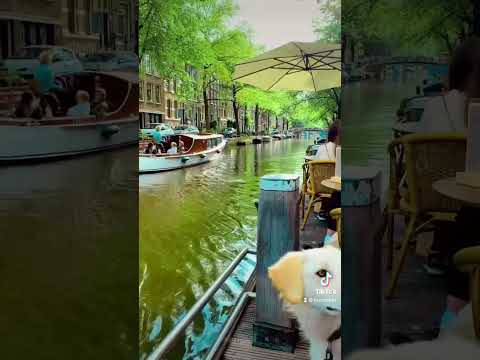 Jordaan, Amsterdam.The OG Channel
-
 Jordaan District: Discover Amsterdam’s Most Neighborhood!Travel Treasures
-
 Hidden gem in the Jordaan | I amsterdamI amsterdam
-
 Jordaan, AmsterdamASA LIFE
-
 Shopping 🛍 the 9 Streets in Jordaan Amsterdam NetherlandsJason’s Point of View
-
 Best things to do in De Jordaan, AmsterdamTravel Lemming
-
 Amsterdam’s Jordaan neighborhood is one of the most beautiful in Euro…Derek and Steph Travel
-
 Why Is Amsterdam’s Most Famous Neighborhood Called the Jordaan?Tales From Amsterdam
History
Its streets follow old polder plots and ditches, which gives the quarter an unusual orientation compared with the rest of the city. For centuries most residents lived in alleys called forten, around courtyards and adjoining houses. About a tenth of these alleys still exist, though not all are still homes. It had long been a typical working-class district of craftsmen and small businesses. By the later 19th century it was overcrowded and impoverished. Traditionally left-leaning, it kept its traditions as it gentrified.
- around 1100Polder plots are laid out here. The street layout still follows them.
- 1612Construction begins. The quarter is called Het Nieuwe Werck, meaning The New Work.
- 17th centuryMany Huguenot refugees settle in the quarter.
- 19th centurySix canals are filled in, including the Rozengracht.
- 1886Police try to stop a banned game at the Zaterdagse Brug. The Palingoproer riots follow and leave 26 people dead.
Show all
- 1934The Jordaanoproer, Dutch for Jordaan uprising, breaks out over cuts to unemployment benefits. Police and army crush it. Seven people die and about 200 are injured.
- 1960sMany original working-class residents move to Almere and Purmerend.
- late 20th centuryHigher-income groups and investors arrive. Gentrification pushes rents sharply up and displaces many longtime residents.
Sources: Jordaan - Wikipedia · Jordaan - Wikipedia · Jordaan - Wikipedia · Jordaan (Amsterdam) - Wikipedia · checked 18 Oct 2026
Questions and answers
Where is The Jordaan in Amsterdam?
The Jordaan is a quarter in the centre of Amsterdam, part of the Amsterdam-Centrum borough. The Singelgracht bounds it to the west, the Prinsengracht to the east, the Brouwersgracht to the north and the Leidsegracht to the south.
Are there free concerts in The Jordaan?
Yes. In summer, some of the courtyards open on Sundays for free concerts called hofjesconcerten.
How many hofjes are there in The Jordaan, and which is the oldest?
Nineteen hofjes, inner courtyards, remained in 2017, and there were once more. The oldest surviving one is the Sint Andrieshofje, dating from 1614, at Egelantiersgracht 105.
Where is the Anne Frank House, near The Jordaan?
The Anne Frank House stands just outside the quarter, on the east side of the Prinsengracht. A statue of Anne Frank stands near her house.
Where is Rembrandt buried, near The Jordaan?
Rembrandt is buried in the Westerkerk, at the corner of Rozengracht and Prinsengracht, just outside the quarter. The exact burial spot is unknown.
Which markets are there in The Jordaan?
Markets run regularly at Noordermarkt and along Lindengracht. The Westerstraat hosts a textile market.
- See who's going — faces, not ticket counts.
- Write to someone who shares your interests — no swipes, no matches, no paywall.
- Pick the event or the place to meet at — and go together.