

 Photo: EVGEN SLAVIN · Unsplash · edited
Tsaritsyno Museum-Reserve
Sign up free — See who's going and message them.
Is this your place? Get the badge for your websiteAbout
More photos 2
1 / 2
 EVGEN SLAVIN · Unsplash · edited

Why go
- The Grand Palace stood unfinished for over 200 years before restorers completed it in 2007 using historical drawings.
- The palace and park ensemble spans more than 100 hectares of hills and ravines, with 19th-century pavilions and ruins.
- Bazhenov’s geometric designs include a semicircular Small Palace and a square Kitchen Building with rounded corners.
Don't miss
- Grand PalaceIts planned design has two equal square wings for Catherine II and Crown-prince Paul; the tower tops echo those of the Moscow Kremlin.Palace ensemble
- Small PalaceNotice its semicircular shape, one of Bazhenov’s geometric designs.Palace ensemble
- Kitchen BuildingLook for its square plan with rounded corners, another of Bazhenov’s geometric designs.Palace ensemble
- Vyatichi burial moundsLook for the surviving Vyatichi burial mounds, which attracted scholarly attention in the 19th century.Park
- Light and music fountainThe fountain stands on Horseshoe Island in the Middle Tsaritsyno Pond.Horseshoe Island, Middle Tsaritsyno Pond
Know before you go
- Animals are not allowed in the park, except guide dogs.
What's inside
- The costume room contains men’s and women’s outfits styled after 18th-century fashion, with hats and accessories.
- Finds from the park’s burial mounds formed the basis of the reserve’s archaeological collection.
With kids
- Young children and preschoolers can join museum programs with their parents.
- School groups can take museum lessons and join game-based investigations and interactive programs.
- Ages 8+: an educational program explores plants, techniques and making artworks.
- Ages 12–17: a dedicated activities project.
- Parent-and-child rooms and food are available in the park.
- The museum offers school graduation events and seasonal celebrations; palace celebrations require an appointment.
Interesting facts4
-

Many buildings bear Masonic symbols; the meanings of many remain unresolved.
Tsaritsyno Palace - Wikipedia (part 2) -
 1944
Excavations in 1944 uncovered tools not previously found in comparable burial mounds in the Moscow region.
Tsaritsyno Palace - Wikipedia (part 2) -
The pond cascade developed between the 16th and 18th centuries; its oldest pond, Borisovsky, dates to Boris Godunov’s reign.
Tsaritsyno Palace - Wikipedia (part 2) -
Catherine II renamed the estate Tsaritsyno, meaning “village of the tsarina.”
Palais de Tsaritsyno - Wikipedia
Shorts
-
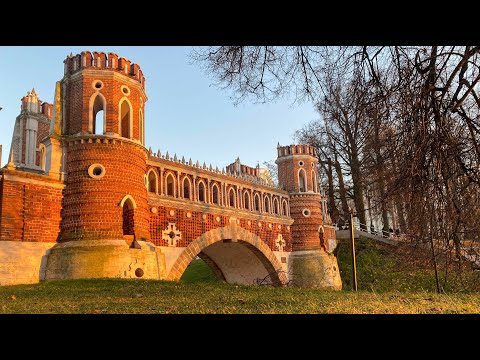 Walk in Moscow. Tsaritsyno Museum-Reserve. Life is in moments.Oleg Lyskov
-
 Grand Palace, Catherine II, Tsaritsyno Museum-Reserve, Tsaritsyno, Mo…My Russian Experience
-
 Tsaritsyno Museum Reserve, Moscow RussiaDr. SADIQ USMAN
-
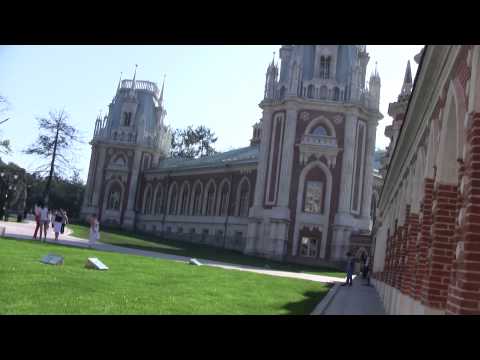 Tsaritsyno museum and reserve in MoscowBetty Sham
-
 Tsaritsyno museum and reserve in MoscowBetty Sham
History
Catherine II commissioned Vasily Bazhenov’s summer residence in 1775. Construction began the next year, but after inspecting the palace in 1785, Catherine ordered a redesign.
- 9th–12th centuriesThe Vyatichi inhabited the area.
- 16th centuryThe estate belonged to Tsaritsa Irina, sister of Boris Godunov.
- 1712Peter I gave the land, then called Tschornaja Grjas, to Dimitrie Cantemir.
- 1722Prince Cantemir rebuilt the church in stone and built a wooden palace on a hill.
- May 1776Construction began on Bazhenov’s three-palace scheme; work continued for a decade amid supply and funding problems.
Show all
- 1785After inspecting the palace, Catherine ordered substantial demolition and a new design. Matvey Kazakov took over, tasked with creating a single palace.
- 1786Construction began on Kazakov’s Grand Palace, the ensemble’s largest building.
- 1796Work stopped after Catherine’s death, with the Grand Palace largely finished but still under a temporary roof.
- early 19th centuryThe estate became a public park, and Ivan Egotov oversaw a landscape redesign.
- 1865The Kursk railway’s Tsaritsyno station opened, improving access from Moscow.
- 1870sA summer cottage village called Novoe Tsaritsyno developed in the area.
- 1880Part of the Grand Palace roof collapsed; the remaining roof and Gothic tower frames were later dismantled.
- 1927A museum opened in the Third Cavalry Corps.
- 1937The museum closed, and the building became a village club with a cinema.
- 1984The museum-reserve that administers the ensemble was founded.
- 2005–2007The palace complex was converted into a museum complex.
- 2007The restored complex officially opened on 2 September.
Sources: Tsaritsyno Palace - Wikipedia · Tsaritsyno Palace - Wikipedia (part 2) · Музей-заповедник «Царицыно» | Официальный сайт · tsaritsyno-museum.ru · Клуб друзей «Царицына» - Музей-заповедник «Цари… · Zarizyno-Park - Wikipedia · Palais de Tsaritsyno - Wikipedia · Царицыно (дворцово-парковый ансамбль) - Wikiped… · Детям - Музей-заповедник «Царицыно» · checked 24 Sep 2026
- Website
- tsaritsyno-museum.ru/
- Phone
- +74953224433
Questions and answers
How is the Tsaritsyno estate laid out?
The Upper and Middle ponds border the ensemble to the west, with some buildings facing them. Ravines bound the grounds to the northeast and south, and greenhouses lie to the east.
How old is the Lower Tsaritsynskiy Pond at Tsaritsyno?
It dates to the 17th century, when the estate belonged to the Streshnev boyars.
When did the Middle Tsaritsynsky Pond form?
It formed in the 1980s, when a high dam divided the Lower Pond.
Which writers and composers visited the Tsaritsyno area?
Dostoevsky, Tyutchev, Tchaikovsky, Chekhov, Andrei Bely and Bunin visited or rented nearby dachas.
When did Moscow take ownership of Tsaritsyno?
Moscow took ownership in 2004 in exchange for another museum.
- See who's going — faces, not ticket counts.
- Write to someone who shares your interests — no swipes, no matches, no paywall.
- Pick the event or the place to meet at — and go together.